From interviews with office managers through a usability test, a Business Model Canvas and a user story map to a clickable prototype: how a travel tool for office management turned into a two-sided marketplace that pools demand and price risk.
Role · Product Manager (team of two with Yannik Munter)Context · IHK certification, Digital Innovation & Product ManagerTimeline · 2026, final presentation 13 July 2026Methods · Interviews · Persona · Sketch & decide · Usability test · BMC · Business case · User story mapTools · Figma · HTML prototype · AI (concept & build)
The starting point
The brief for the final exam: we are product managers at a travel company that wants to push the digitalisation of business travel with a new, sustainable product.
Early research showed real demand, above all in one group: office managers. They plan trips for other people, align budgets with management and chase receipts afterwards. Interviews with this group gave us first problem statements from the customer’s point of view and a persona to stand in for them.
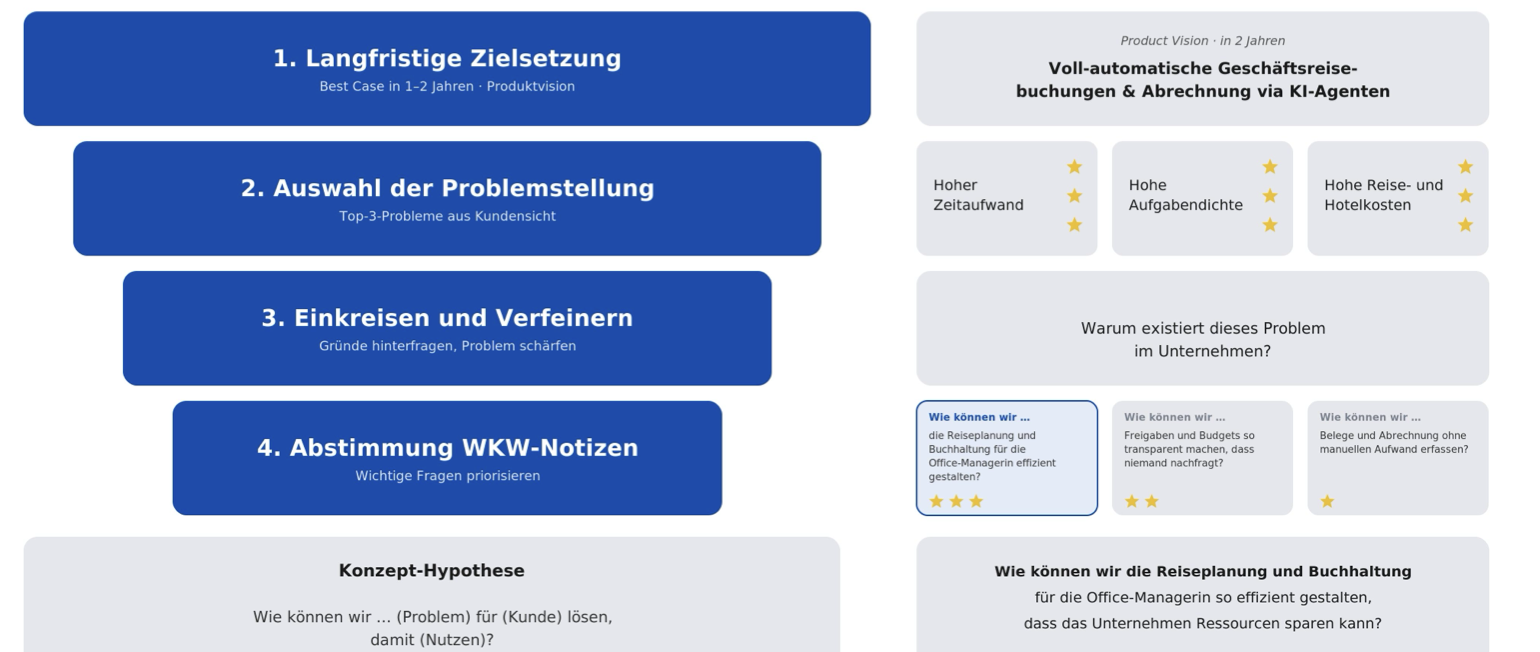
Product vision, two years out
Fully automated booking and expensing of business trips by AI agents: people decide instead of administrating.
My role
Together with Yannik Munter I developed the product (called “TripDesk” in the exam, Tabby today) through the whole concept process: problem selection, solution sketches, storyboard, prototype and usability test, then business model, business case and the user story map for the MVP.
After the exam I kept going on my own. The business-case numbers raised a different question than the one we had started with, and the answer became the marketplace model shown in the prototype at tabby.peter-spiegel.com. I built the concept and the prototype with AI.
Concept hypothesis
How might we make travel planning and expensing so efficient for the office manager that the company saves resources?
01
Understand: which problem are we solving?
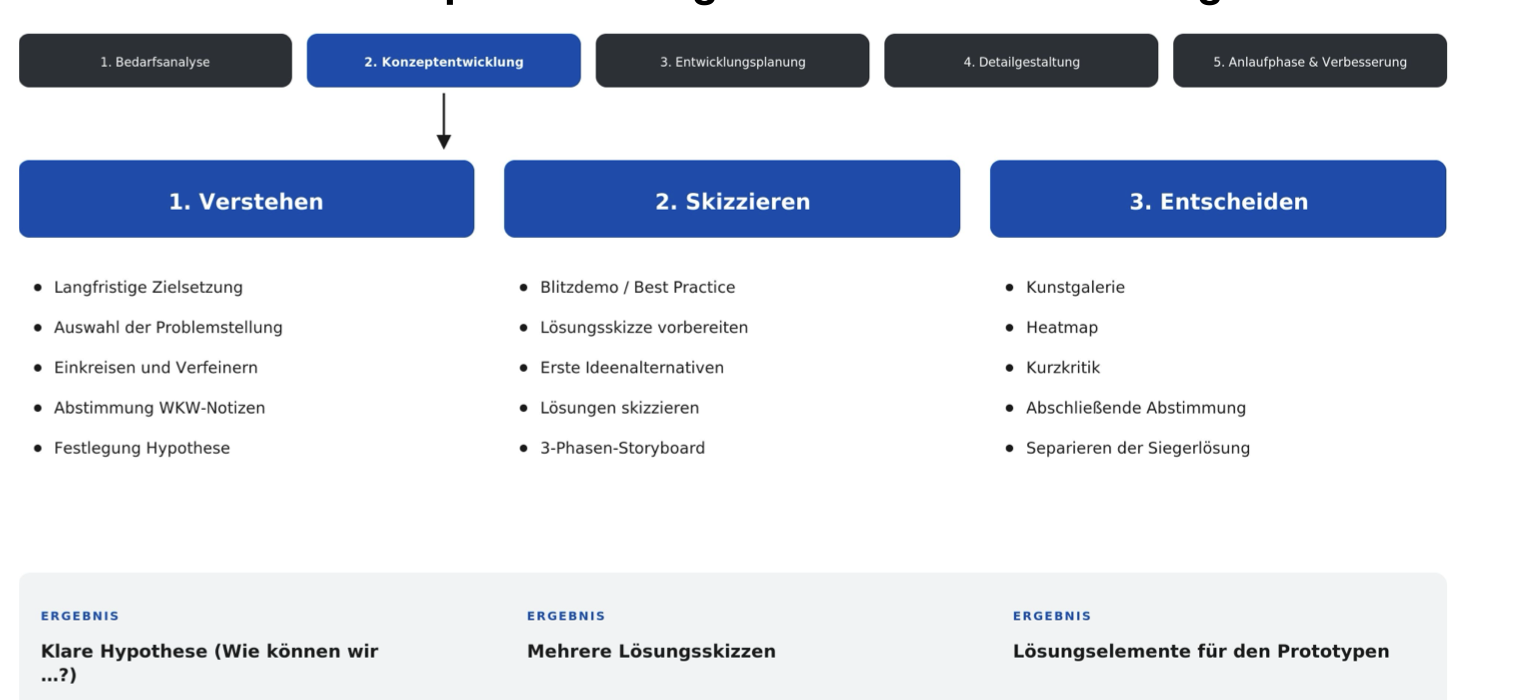
We worked agile and customer-centred rather than waterfall or stage-gate, so real needs would shape the product early and mistakes would surface early in tests. Concept development ran in three phases: understand, sketch, decide. Each phase ended with a clear result.
Test customers
Early validation
Office managers from the target group test the concept on the prototype.
Experts
At least five perspectives
Finance, marketing, customers, technology and design, so desirability, feasibility and viability are judged together.
Decider & facilitator
Clear ownership
The decider makes the critical calls (six super votes); the facilitator keeps the team on track.
Guiding questions
The questions that sharpened the problem.
The interviews surfaced three core problems for the office manager: a lot of time spent, a dense workload and high travel and hotel costs. Before looking for solutions we questioned the problem and ranked the questions as how-might-we notes.
Why?
Why does this problem exist in the company at all?
Trips are pieced together across many portals, approvals happen by email and receipts arrive after the trip, often incomplete.
HMW · ★★★
How might we make travel planning and expensing efficient for the office manager?
Top priority: this became the concept hypothesis.
HMW · ★★
How might we make approvals and budgets so transparent that nobody needs to ask?
Became the approval flow for management.
HMW · ★
How might we capture receipts and expenses without manual effort?
Became the receipt scan with automatic matching.
02
Sketch & decide
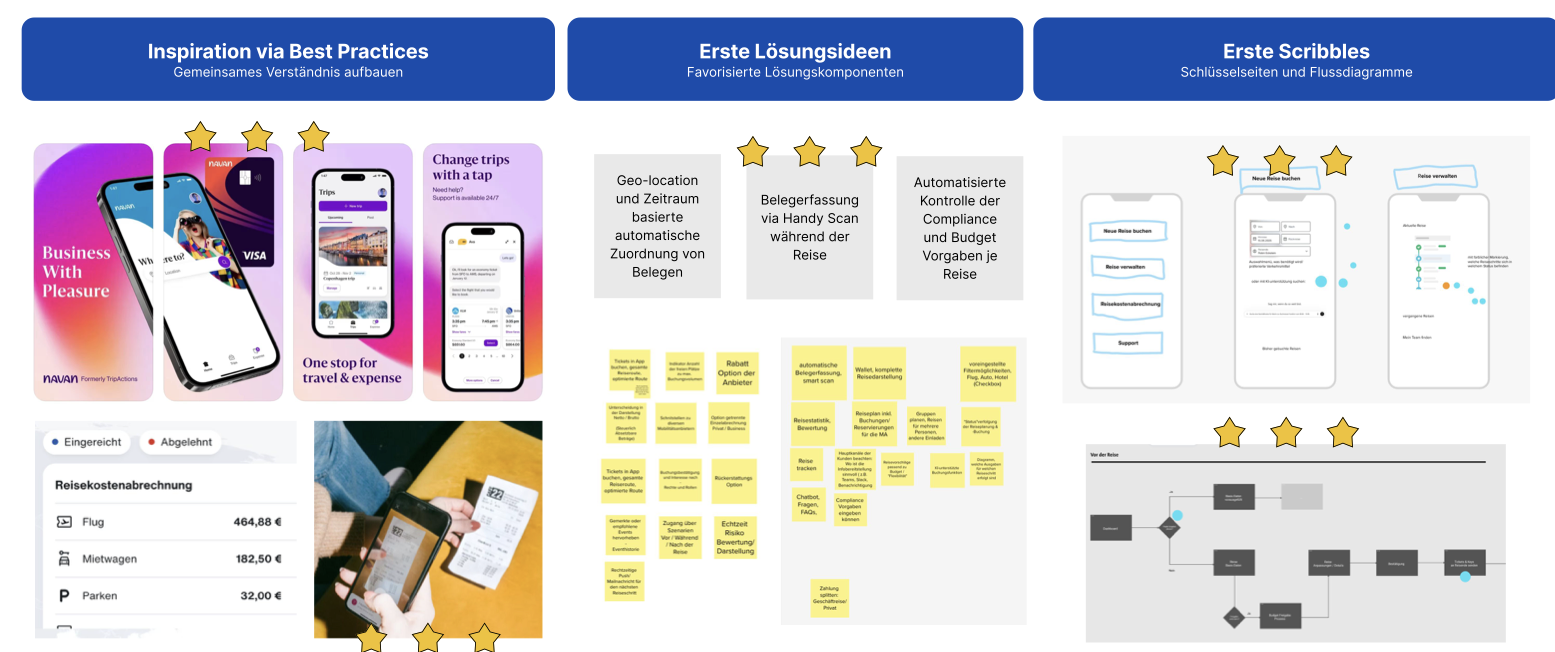
We collected best practices from travel and expense apps, sketched solution ideas and dot-voted three favourite components. These three carried the prototype:
Component 1
Receipt scan on the phone
Travellers photograph receipts during the trip instead of collecting them afterwards.
Component 2
Automatic matching
Location and time window assign every receipt to the right trip automatically.
Component 3
Compliance & budget
Every trip is checked against policy and budget automatically, with a traffic-light signal.
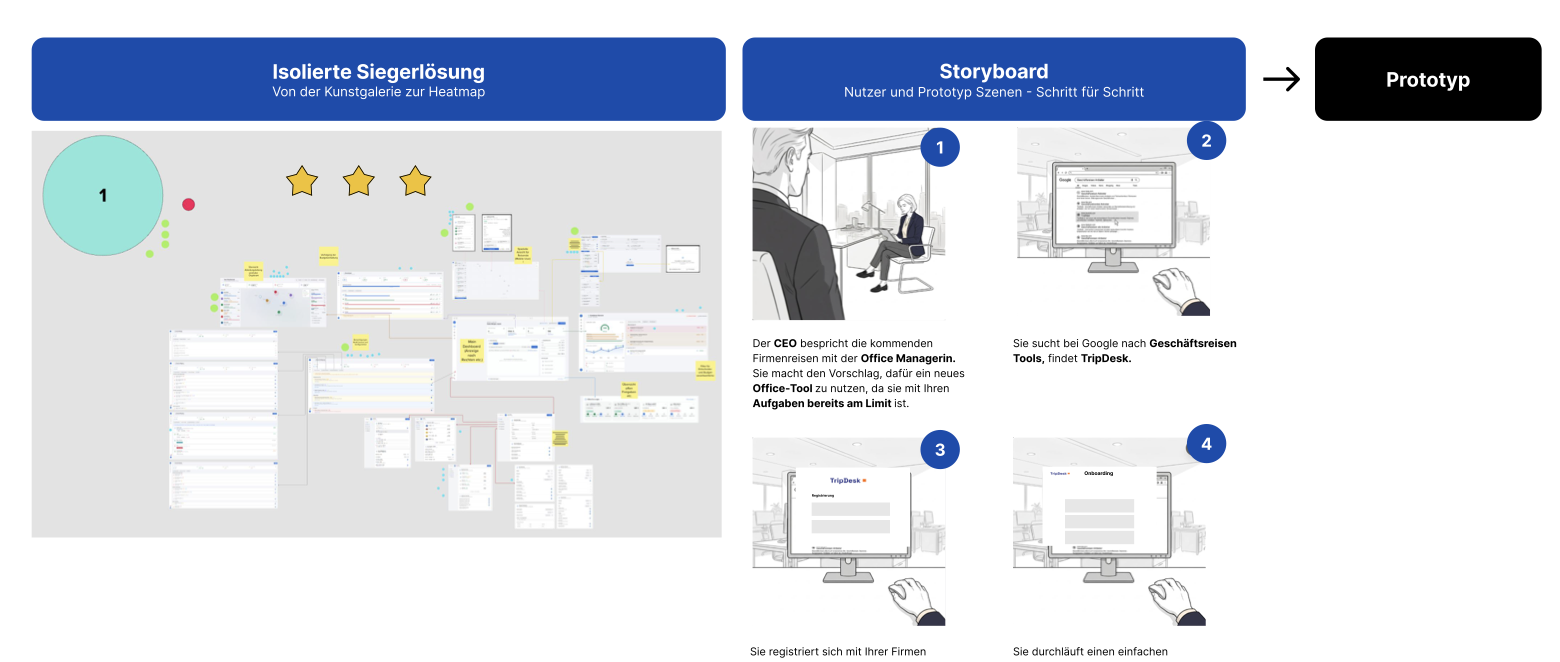
In the decide phase we isolated the winning solution (from art gallery to heatmap) and turned it into a storyboard. The CEO discusses upcoming company trips with the office manager. She is already at her limit, googles for a tool and finds ours. She signs up with her company address, invites the CEO and brings every employee in during onboarding.
03
Usability test: what the office managers told us
Test setup
Participants from the target group work on the prototype
Task-based, with open questions and thinking aloud
Every observation goes on its own sticky note: I like · I wish · I wonder · What if
Then clustered by theme, top 3 per category, a pattern once two people react the same way
Test tasks
Task 1: Book the cheapest trip for a group of five employees visiting a trade fair.
Task 2: Find the current business trip that is over its planned budget.
Task 3: Book flights and hotels within the early-booking window to save costs.
Sticky notes
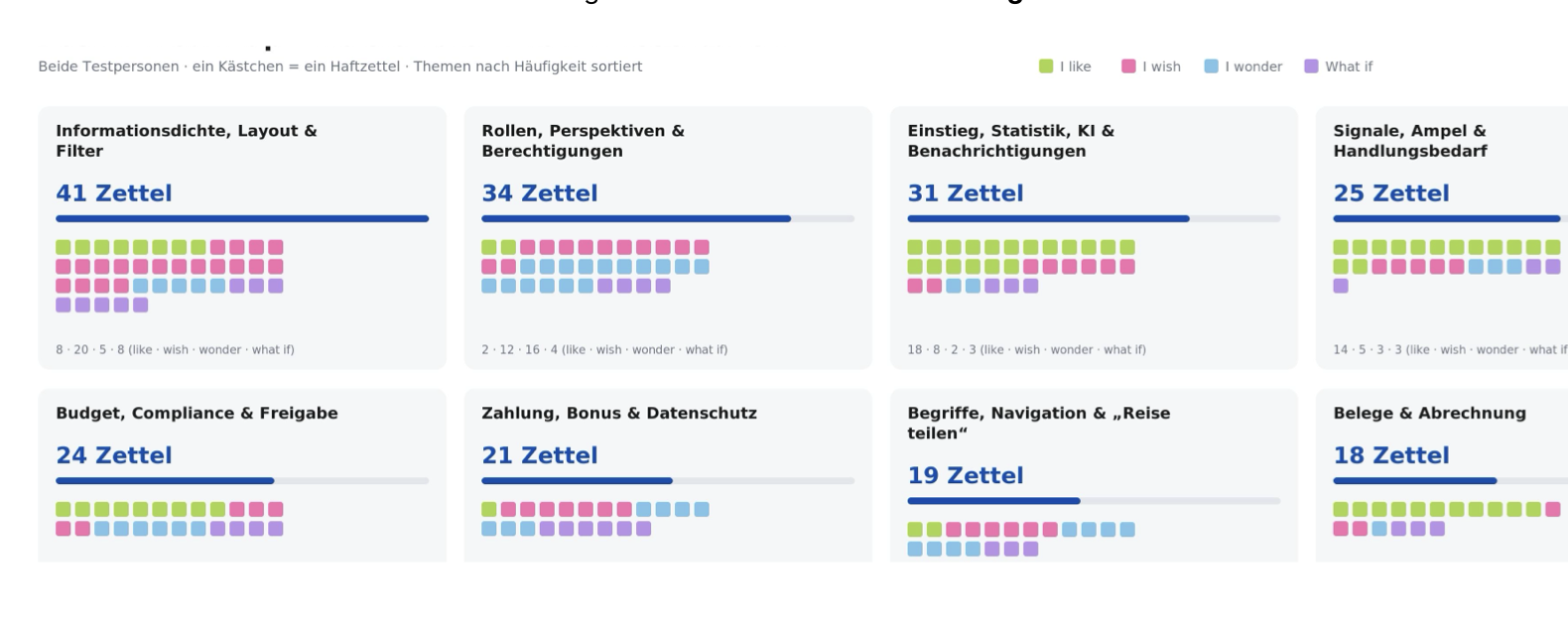
213
individual observations from the tests, clustered into eight themes
Largest theme
41
Information density, layout & filters
Second
34
Roles, perspectives & permissions
Third
31
Entry point, statistics, AI & notifications
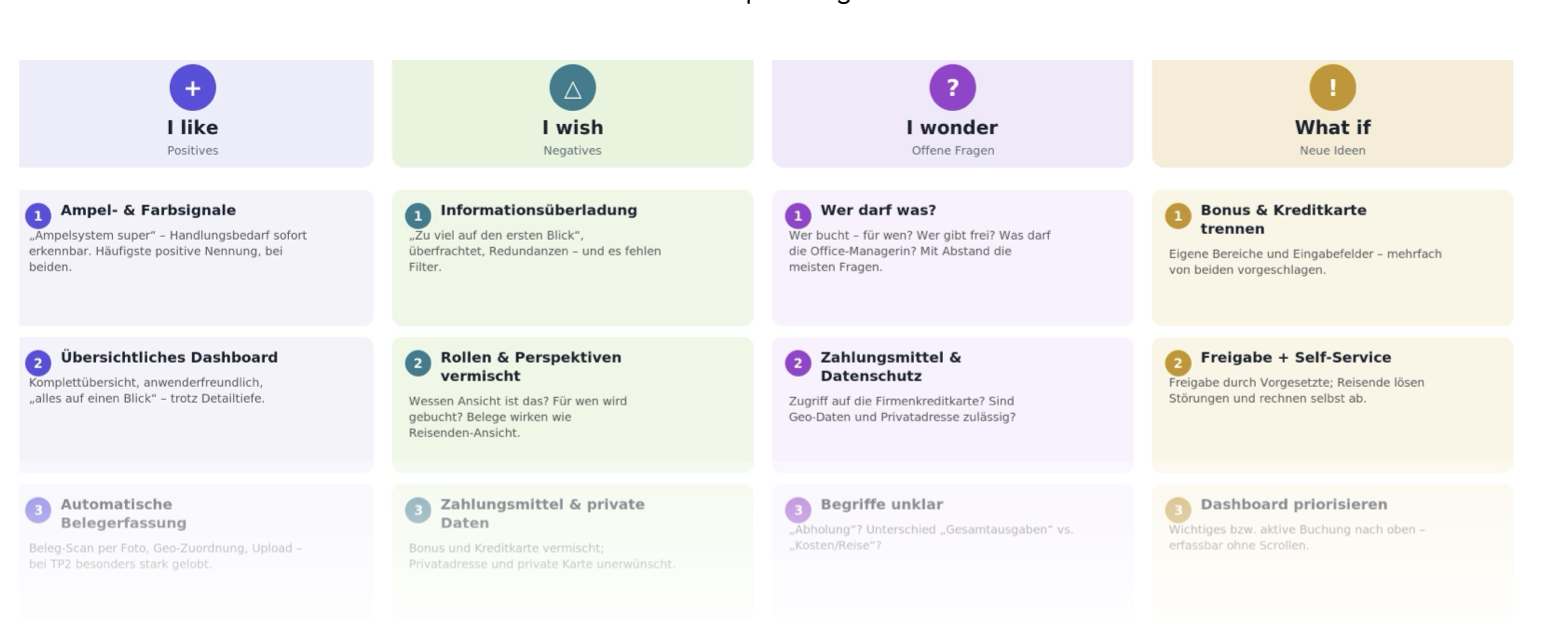
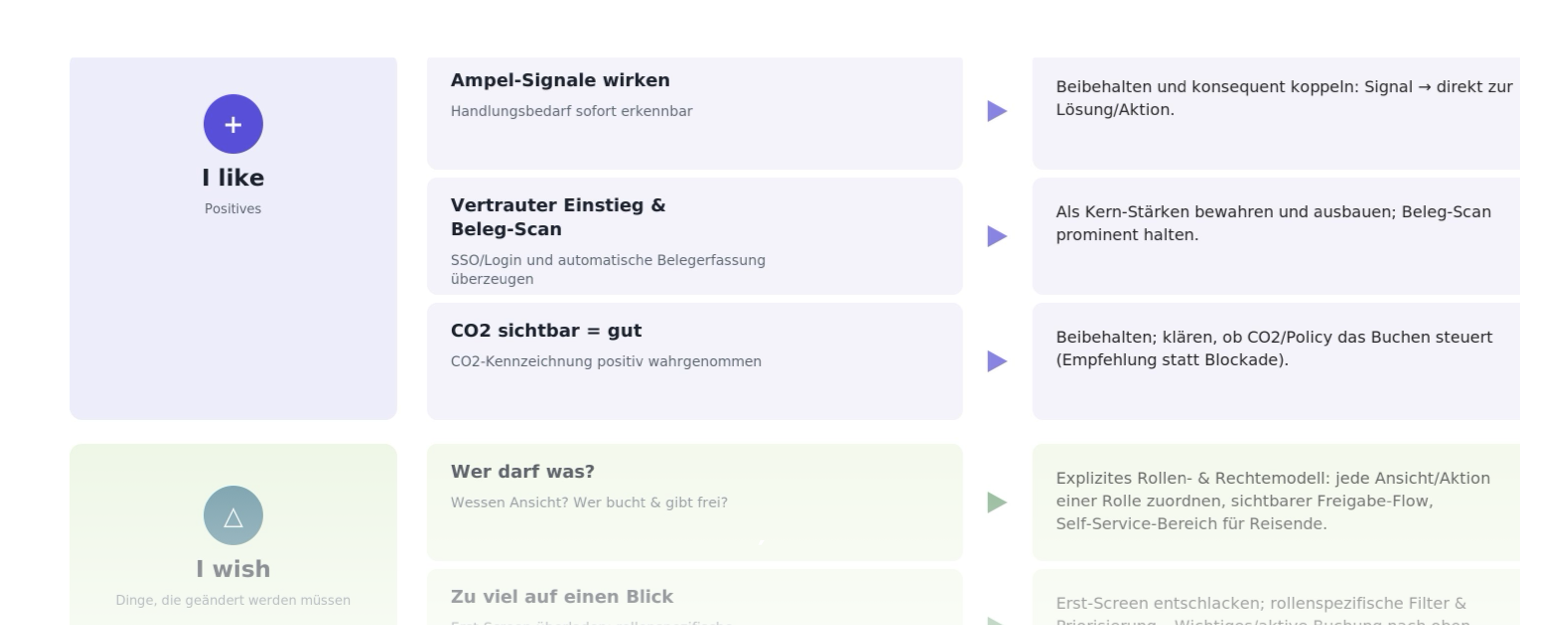
1
Traffic-light signals work
“The traffic-light system is great”: the most frequent positive comment from both participants. The need to act was obvious at a glance, and the clear dashboard and receipt scan landed too.
Recommendation: keep it and link it consistently, so every signal leads straight to a fix.
2
Who may do what?
The most open questions: Who books for whom, who approves, what is the office manager allowed to do? Receipts looked like the traveller’s view, and the perspectives were mixed up.
Recommendation: an explicit role and permission model, a visible approval flow and a self-service area for travellers.
3
Too much at once
“Too much at first glance”: the entry screen was overloaded and role-specific filters were missing. Questions about the company credit card and data privacy came on top.
Recommendation: slim down the entry screen and filter by role, put active bookings first, separate bonus programmes from the credit card.
Overall test verdict
Effective failure
The prototype doesn’t work, but delivers essential insights.
Flawed success ✓
Some ideas met the needs, others didn’t. So: improve and test again in another iteration.
Epic win
The concept fully meets customer needs.
04
Business model & business case
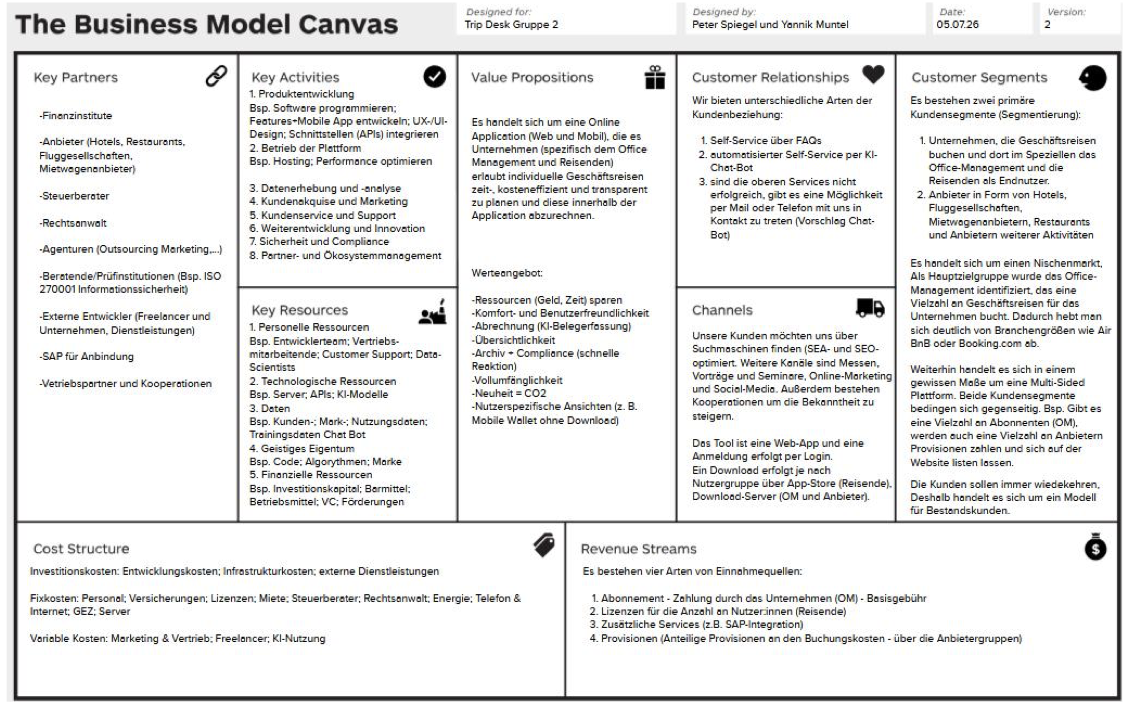
The value proposition in the Business Model Canvas follows directly from the test feedback: a web and mobile application that lets companies (specifically office management and travellers) plan business trips efficiently in time and cost, and expense them inside the app. It covers saving resources, AI receipt capture, clarity, archive & compliance, CO₂ transparency and a mobile wallet that needs no download.
Market: Germany as the base
TAM
€1.27 tn
global business-travel revenue 2025, back at the pre-Covid record level of 2019
SAM
116.1 m
business trips in Germany 2025, worth €48.6 bn
SOM · year 1
18,000
bookings and 1,800 subscriptions in the business case
Buyer vs user
Management buys, office uses
Purchase decision with management, main use in office management
Sources: VDR Business Travel Report 2025; Fortune Business Insights (2026).
We translated what the test and the business case taught us into one central user story. Three role stories hang below it and together make up the system. That also answers the biggest open question from the test: who may do what.
As an office manager in a company, I want to plan, book, get approval for and expense my team’s business and trade-fair trips in a single tool, supported by an AI agent, so that I can plan at early-bird prices, still stay flexible and meet budget and compliance rules automatically.
Decider · CEO
Cost control without the day-to-day
Approves trips and budgets visibly and spots overruns immediately.
Traveller
Able to act on the road
Manages trip, tickets and receipts on the phone. When something breaks, an alternative arrives automatically.
AI agent · system
The agent does the admin
Books and monitors trips, rebooks and matches receipts on its own.
Acceptance criterion (Gherkin)
Scenario: The AI agent proposes a complete, resource-optimised trip plan.
Given
I create a team trip for five travellers to the IAA in September,
When
I enter destination, dates and occasion,
Then
the AI agent proposes a complete package of hotel, train/flight and trade-fair ticket,
And
the proposal shows total price, CO₂ value and policy compliance.
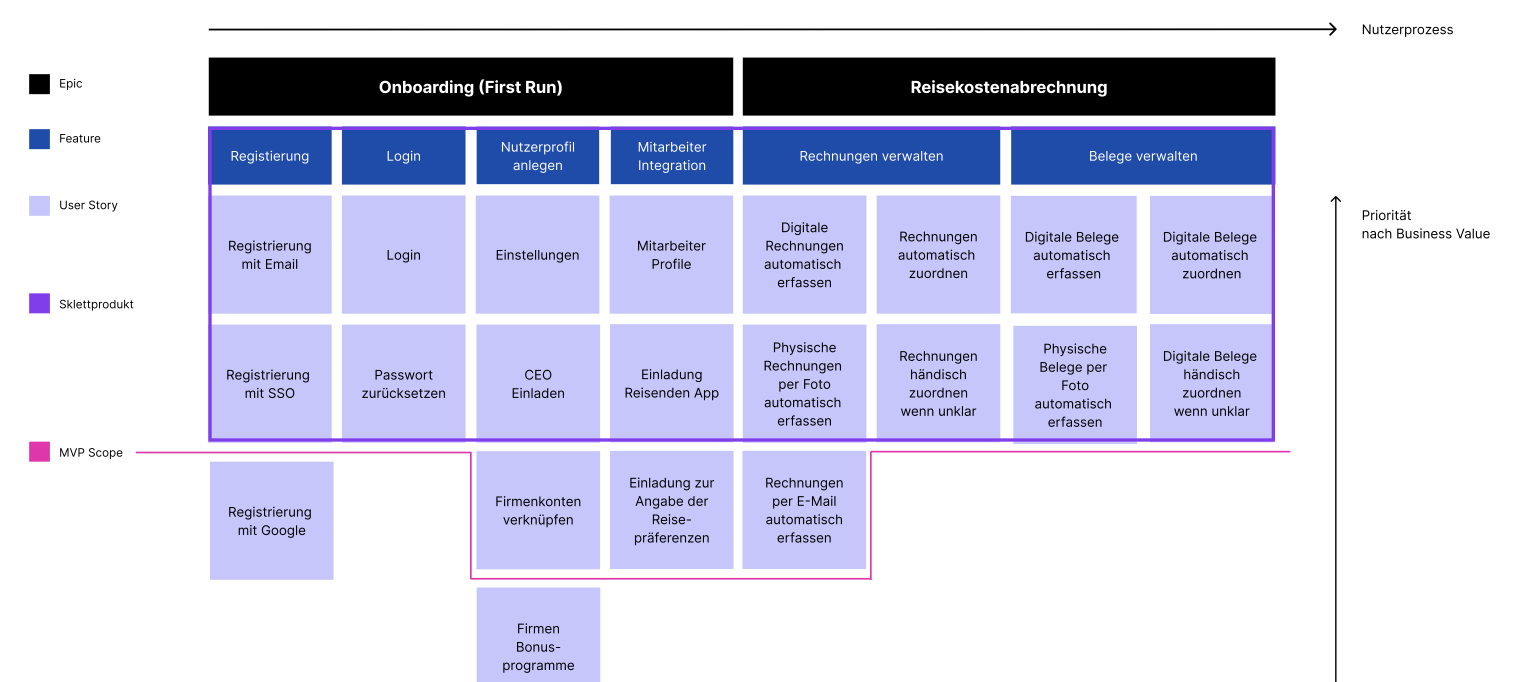
Epics follow the user’s process, with features and user stories below them, ordered by business value. The lines separate the walking skeleton from the MVP scope.
06
From tool to marketplace
The business case holds up, but it also shows its limits. More than half the revenue comes from subscriptions. On the booking itself the tool earns €6 on average. In the worst case the NPV is barely €4,000. And a pure time-saving tool hardly touches the third core problem from the interviews, high travel and hotel costs: at a trade fair you pay the peak price however efficiently you booked.
The new question
What if we didn’t just simplify booking, but took on the price risk ourselves?
Early purchasing
Tabby secures fixed allotments early, for inventory that is volatile and peak-priced but predictable (trade-fair hotels, mobility, venues).
Risk pooling
Occupancy and price risk are pooled across many clients. The pool absorbs the swings, not the individual customer.
Late flexibility
Travellers and dates stay changeable until shortly before the trip. When something critical changes, the agent re-optimises.
Two sides, one mechanism
Customers (office management, executives, travellers) get a predictable fixed price and full flexibility. Partners (hotels, mobility, event providers) get pooled demand secured early instead of last-minute hope, and keep control of their terms and brand.
Deliberately not for
Freelancers: planner, traveller and budget owner are the same person. There is nothing to delegate, the volume is tiny and there is no ERP. Tabby is a tool for companies with separate roles.
Buyer journey: a trade-fair trip to Munich
The market climbs towards the fair while the customer’s price stays flat. The pool manages the difference (example figures per night).
≈ 9 months before
Early purchase
€110
Tabby buys a fixed room allotment early, cheap because it is early and in volume.
Pool
≈ 4 months before
Fixed-price booking
€150
The customer books at a guaranteed fixed price without committing to details.
Customer
Until shortly before
Flex window
€150
Change travellers and dates without rebooking fees.
Customer
2 days before
Employee falls ill
≈ €360–415
Market price. No cancellation fee: the room goes back into the pool.
Customer
Fair day
Resale
€415
Tabby resells the freed-up room at peak price: +€305 per night.
Pool
Data: where the spread is largest
The 2025 hotel peaks double as the go-to-market order. The best markets for the pool spike high, come back every year and are easy to forecast. Six of them are in the home market.
Munich
+200–400%
Oktoberfest, IAA Mobility, bauma. Peak ADR ~€415, ~50% of hotels sold out on top nights.
Düsseldorf
~77% booked
K, drupa, MEDICA. During K 2025, up to ~77% of hotels were unavailable on the peak day.
Frankfurt
~73% booked
CPHI, Automechanika, Light+Building, Book Fair: a tightly packed trade-fair year.
Berlin
2–4× rate
ITB, IFA. 92% occupancy during ITB.
Hanover · Cologne
recurring
Hannover Messe, Gamescom, Anuga: reliable major events with high demand for beds.
Barcelona · Las Vegas
+80–400%
MWC, CES. International benchmarks for later.
The catch on the supply side: in exactly these cities, hotels often reserve their peak inventory exclusively for official trade-fair housing partners.
What we’re betting on, and where the danger is
Resale needs two things at once: a room that has become free and a market that is still hot. Tabby bets on individual, independent dropouts, not on a recession.
Loss · danger
Many dropouts, weak demand
Recession or a wave of insolvencies: many allotments come free, but nobody wants them. The capital is tied up in rooms nobody books.
Profit
Many dropouts, peak demand
Individual travellers drop out while the fair is booming. The room sells at the top price.
Thin margin
Few dropouts, weak demand
A quiet market. The pool covers its costs but hardly earns.
Spread margin
Few dropouts, peak demand
Business as usual. The margin comes from the planned spread: the bread-and-butter scenario.
Correlation is the crux. The pool is only robust if dropouts are unrelated to market demand. A dominant client, a single fair or a single industry ties the two together, and you end up in the red quadrant. So the whole margin depends on how well the pricing engine forecasts. That engine is the real moat, not the interface.
Outlook scenario
An anchor client with group travel.
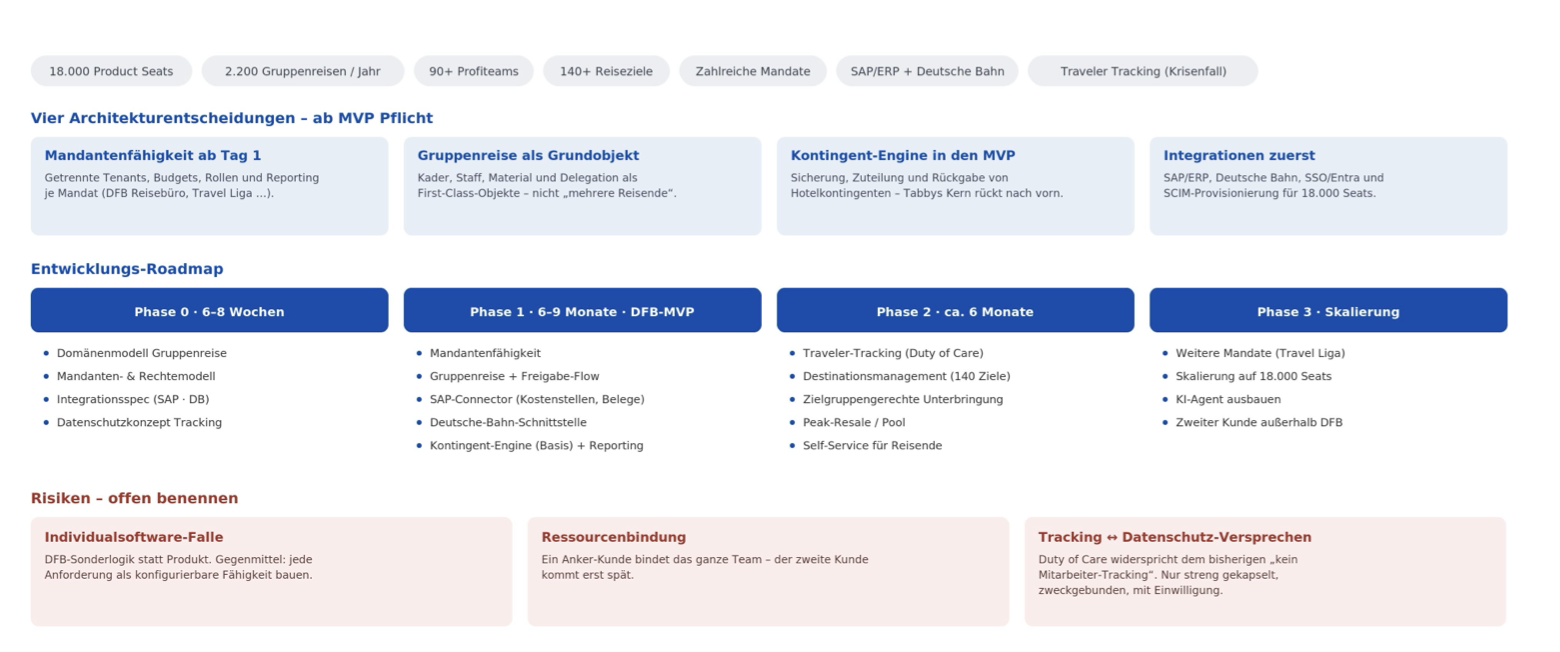
To close the presentation we ran the model through an enterprise scenario: the German Football Association’s travel agency (DFB-Reisebüro) as a possible first client, with around 18,000 travellers, more than 1,400 team trips a year and over 140 destinations. That adds multi-tenancy, group trips as the core object, an allotment engine, SAP/ERP and rail integration, and traveller tracking for emergencies.
GMV year 1
€25.4 m
booking volume through the platform
Contribution margin
≈ €4.3 m
per year
Break-even
~6 months
in the scenario
NPV · 4 years
+€9.8 m
at a 12% discount rate
The risks are named openly too: the custom-software trap, one anchor client tying up the whole team, and the conflict between traveller tracking and the promise not to track employees.
Clickable prototype
Try Tabby.
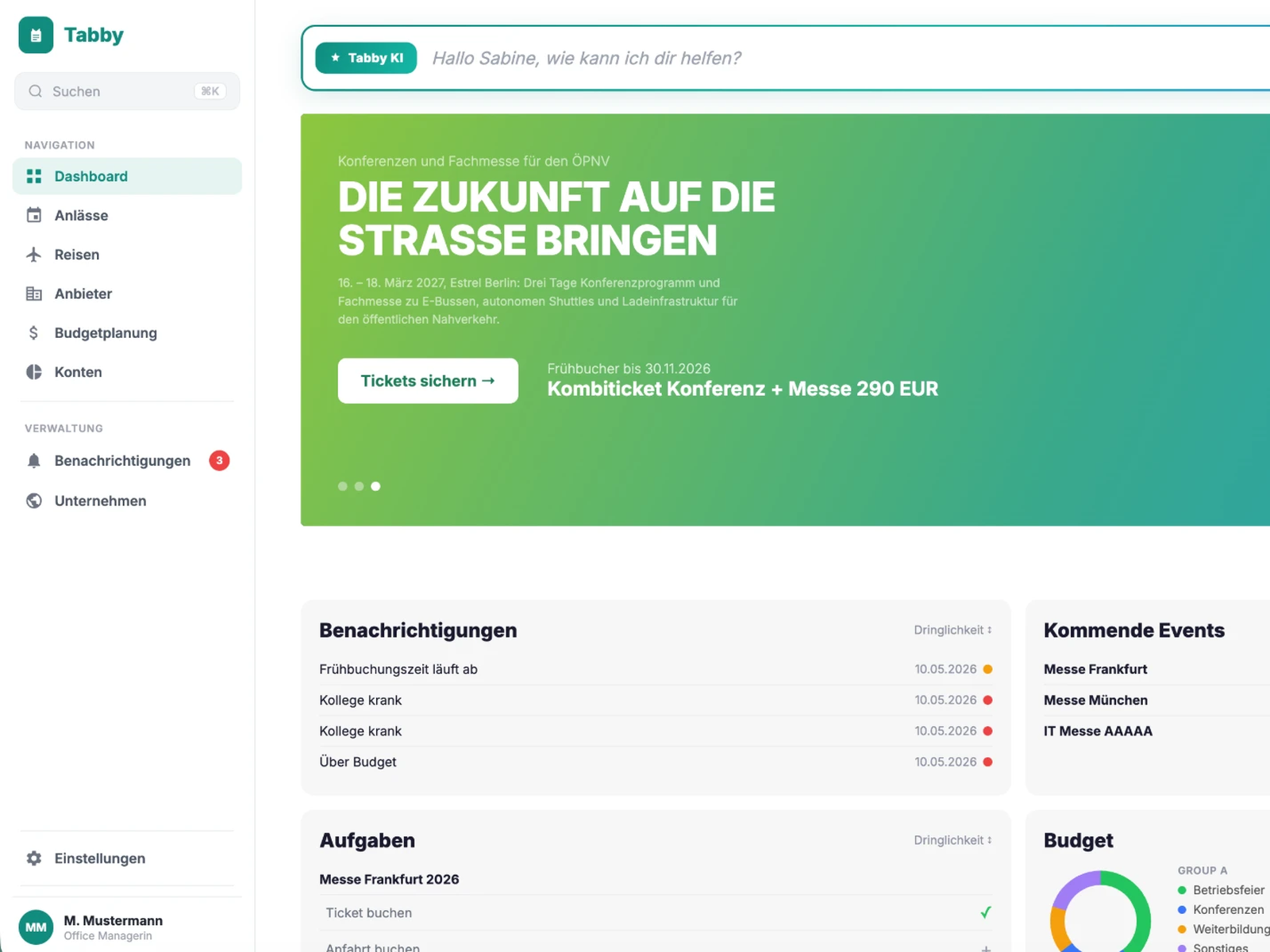
The prototype runs on its own address: the office dashboard with wallet, occasions and trip planning, plus the reasoning as interactive pages. There you’ll find the revenue calculator with worked examples, the data page, personas you can question, and the system architecture with its roadmap. The pages are in German.
I saw it as a mandatory part of the exam. In fact it asked the most important question of the project: what does the product earn on, and which customer problem gets left behind?
“Who may do what?” is a product question
Most sticky notes in the test weren’t about pixels but about roles. In B2B tools with several parties, the permission model has to come before the interface.
Name the risk instead of hiding it
The marketplace model lives on a bet. Only once I had written down clearly when it loses could I defend the model honestly.
From concept to prototype with AI
I built the prototype, the calculators and the personas with AI. That let me test every hypothesis as a clickable page instead of describing it on slides.
If I could do it again
“I would interview the hotel and mobility providers as early as the understand phase. The second side of the marketplace only came in through the numbers, and it is still the least validated.”